
MCF–Rush City Release Paths
MCF–Rush City is a Minnesota Department of Corrections prison for adult men. Its population consists of people committed to the Commissioner of Corrections. The county jail system does not control this prison record, and the Chisago jail locator is the wrong search. When someone leaves the facility, the DOC record should show whether state prison custody ended through supervised release, a program release, transfer, release to another authority, or sentence discharge.
Supervised release means the person serves part of the executed state sentence in the community under DOC authority. It is not discharge. A transfer to another DOC prison also is not community release. Discharge means the DOC sentence or supervision authority reflected in the official record has ended. These terms explain why the person’s current status and location must be read together.
| DOC outcome | Meaning | Confirmation path |
|---|---|---|
| Incarcerated at MCF–Rush City | Current state prison custody | DOC Locator status and facility |
| Transferred | Custody continues at another DOC facility | New facility in current DOC record |
| Supervised release | Person is outside prison but still under the executed sentence | DOC status, district, and agent |
| Program release | A named DOC release program governs community status | Program wording and effective date |
| Released to another authority | State prison stay ended but other custody may continue | Receiving agency record |
| Discharged | DOC authority shown by the sentence record has ended | DOC discharge or expiration data |
Search MCF–Rush City Releases
The Minnesota DOC Locator is the public search for adults committed to the commissioner. Search the person’s name as the application permits, compare the date of birth, aliases, and six-digit MNDOC offender ID, then open the detail. The record can identify current status, facility, sentence information, county and court file, highest-ranked offense, expiration date, caseworker or agent, and an Anticipated Release Date for an incarcerated person.
- Search the DOC public viewer by the person’s identity and open the matching state record.
- Confirm the six-digit MNDOC number, birth information, and aliases before reading status.
- Read current status with the named facility or supervision district. A new prison location is a transfer.
- Treat Anticipated Release Date as a projection. Look for status text showing release under a named program or supervised release as of a date.
- If the detail is unclear or no longer retained publicly, request existing release, sentence, transfer, and discharge data from DOC Central Records.
The successful DOC public viewer capture shows the correct state search channel.
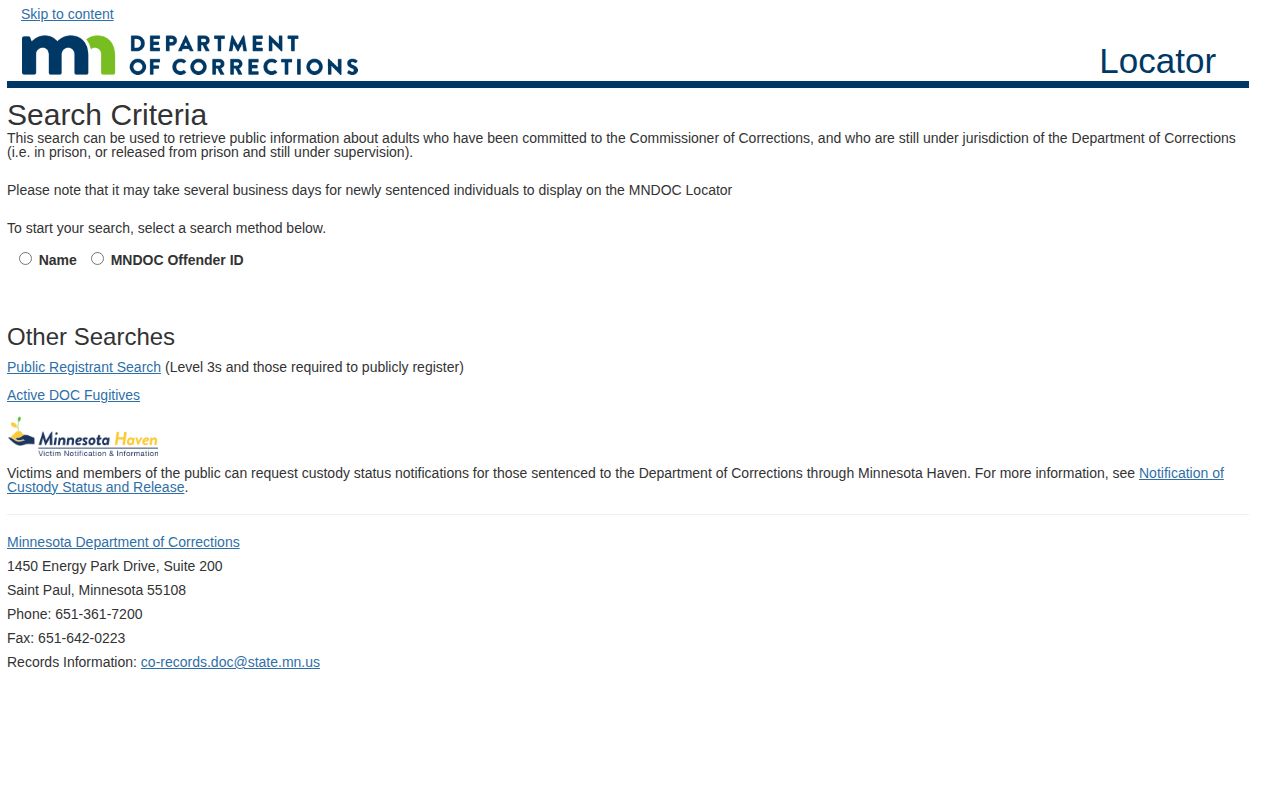
The state status, supervision language, and actual event evidence carry more weight than a projected date viewed by itself.
Note: Preserve the six-digit MNDOC number because it helps Central Records match the correct MCF–Rush City sentence record.
MCF–Rush City Release Fields
A DOC detail record is designed around state correctional jurisdiction. It may contain front and side DOC photographs, the MNDOC ID, recorded name and aliases, birth date, present status, sentence date, highest-ranked offense, county and court file, expiration date, and caseworker or supervision agent. An incarcerated record can display the exact label Anticipated Release Date.
| Field | Released-person value |
|---|---|
| MNDOC offender ID | Connects the public result to a focused state records request |
| Current status | Separates incarceration, community supervision, and discharge |
| Facility or district | Shows prison location or community supervision office |
| Anticipated Release Date | States the current projection, not proof that release occurred |
| Program release wording | Can identify a named release program and effective date |
| Expiration or discharge data | Addresses the end of DOC authority when available |
| Agent or caseworker | Identifies the responsible DOC contact shown publicly |
An inspected community record used wording such as “Under CIP Program Release as of” a stated date and named a supervision district and agent. That status is stronger evidence of state prison release than disappearance from a facility list. CIP refers to the Challenge Incarceration Program, a specific DOC release program, and its status does not mean the sentence has been discharged.
Request MCF–Rush City Records
DOC Central Records and the department’s data-practices process are the formal fallback. Use the six-digit MNDOC offender ID, full name, birth date, MCF–Rush City, and a useful date range. Ask for existing public sentence, status, transfer, release, supervised-release, and discharge data. State which event matters. A request for “release” alone may not distinguish release to the community from transfer or the later end of supervision.
co-records.doc@state.mn.us
Use the DOC data-practices request route for formal public-data requests
The Minnesota DOC data-practices page gives the current request procedure. Ask the department to identify the statutory basis for any withheld or redacted data. The state route is authoritative for a release from MCF–Rush City. The Chisago County Sheriff’s Records Management Division is not the custodian for a later prison release after commitment to the commissioner.
DOC describes the locator as covering adults committed to the commissioner who remain under its jurisdiction, whether incarcerated or released and still supervised. That scope creates an important historical limit. A person whose DOC jurisdiction fully expired may no longer be a complete public-viewer result. A focused records request can address the older event.
MCF–Rush City Release Dates
Minnesota’s ordinary modern sentence framework uses a two-thirds imprisonment and one-third supervised-release baseline for most qualifying offenses committed on or after August 1, 1993. It is not a general 85-percent rule. Disciplinary confinement, conditional-release terms, consecutive sentences, detainers, court amendments, and specialized release programs can alter a simple calculation.
The Minnesota Rehabilitation and Reinvestment Act adds earned incentive release credit for eligible people. Current law permits up to 17 percent of the total executed sentence to reduce the imprisonment term, while imprisonment cannot fall below one-half. The total sentence remains unchanged. Credits can be revoked for specified misconduct, and life, older indeterminate, and older-good-time categories are excluded. A hand calculation cannot reliably reproduce the official DOC date.
Other legal inputs can move the date without changing the identity of the facility record. Disciplinary confinement can delay the start of supervised release. Consecutive terms, an amended award of jail credit, a conditional-release term, or a new court order can change the computation. A detainer may cause the person to leave DOC custody for another authority rather than enter the community. For that reason, the public viewer’s date should be treated as the department’s current projection. The status posted after the event, followed by the release or transfer record when needed, establishes what actually occurred.
State release-day rules also depend on offense date. For crimes before August 1, 1992, certain Friday, weekend, or holiday dates move to the preceding qualifying day. For later crimes, they move to the first later day that is not Friday, Saturday, Sunday, or a holiday. This is a state supervised-release rule. It is not a county-jail weekend policy.
Note: Always pair an Anticipated Release Date with current DOC status because a projection can change before the custody event occurs.
MCF–Rush City Release Notifications
Minnesota uses two different notification systems. VINE connects only to Minnesota county jails. It is suitable for a Chisago County Jail booking but not for MCF–Rush City. Minnesota Haven covers people in DOC facilities and those under DOC community supervision. Haven is the proper notification channel for a Rush City prisoner or supervised-release client.
The official Minnesota Haven page explains custody-status and release notification, and the program telephone is 800-657-3830. A notification should still be checked against the DOC status or state record. Alerts convey events supplied to the service, while the underlying DOC record supplies sentence and jurisdiction context.
A transfer within DOC may produce a custody change without community release. The same caution applies when the record shows another authority. The named destination determines the next confirmation step.
Note: Minnesota Haven alerts do not replace the DOC record that distinguishes transfer, supervised release, and final discharge.
MCF–Rush City Contact
The Minnesota Department of Corrections operates MCF–Rush City as a state prison for adult men. It is physically located in Chisago County but is not operated by the Chisago County Sheriff. Its records, status, transfers, releases, and discharge data remain part of the statewide DOC system.
7600 525th Street
Rush City, MN 55069
The official MCF–Rush City facility page is the current source for facility contact and operational information. Release-record questions should use the DOC Locator and Central Records rather than treating the prison as a county jail.
After an MCF–Rush City Release
A community release usually begins supervised release or a named release program. The public DOC record may identify the supervision district and agent. The sentence remains active until discharge or expiration. A person can therefore be physically outside prison while still under DOC control. A later violation, warrant, or disciplinary matter has its own official record and should not be inferred from a date alone.
If the person transfers to another DOC facility, the new facility should appear with an incarcerated status. A release to a federal, county, or other authority calls for that receiving agency’s record. No result in one locator is not enough to establish freedom from custody.
The Chisago County released inmate search paths compare DOC status with sheriff, court, federal, and immigration records. The sibling Chisago County Jail release page covers local jail events, which follow a separate records chain.